
 By Brooke Steinberg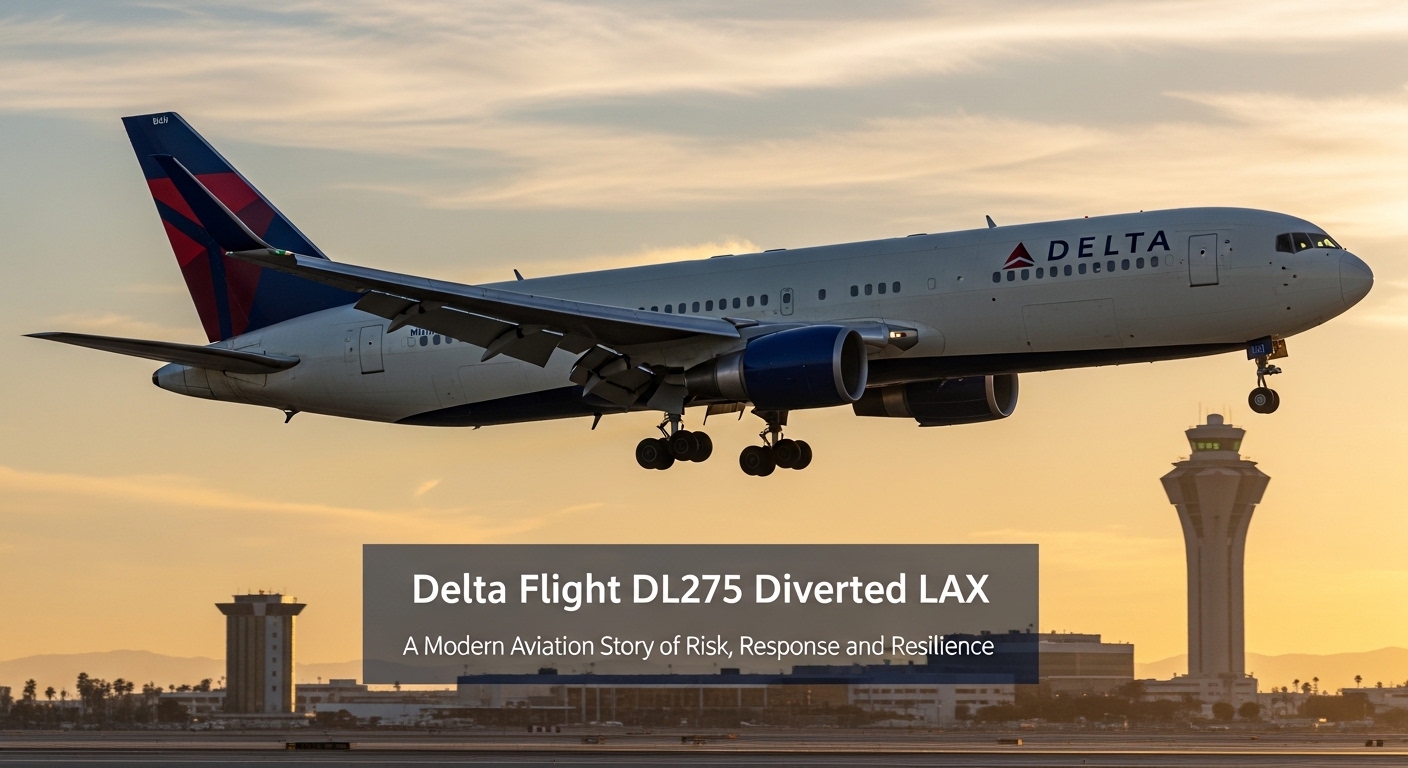
It began like any other long-haul journey—quiet anticipation at the gate, the low hum of engines preparing for departure, and passengers settling into the familiar rhythm of international travel. But somewhere over the vast expanse of the Pacific, routine gave way to urgency. The story of Delta Flight DL275 Diverted LAX is not just an isolated aviation incident; it is a window into how modern air travel manages uncertainty, safeguards lives, and balances operational precision with human judgment.
For entrepreneurs, tech leaders, and systems thinkers, this event offers more than headlines. It reveals how complex systems behave under pressure—and how resilience is engineered into the invisible infrastructure we rely on every day.
The Flight That Didn’t Go as Planned
Delta Flight DL275 was scheduled as a transpacific route connecting major global hubs. These flights are meticulously planned operations involving advanced navigation systems, predictive maintenance checks, and coordinated air traffic management across continents. Yet, even in this highly optimized ecosystem, unexpected variables can emerge.
Mid-flight, something triggered a decision that would alter the aircraft’s trajectory: a diversion to Los Angeles International Airport (LAX). While details of such events often vary ranging from technical alerts to medical emergencies the significance lies in the response rather than the cause.
The phrase Delta Flight DL275 Diverted LAX quickly gained attention, not because diversions are rare, but because they represent a critical moment when systems shift from efficiency mode to safety-first execution.
Why Flight Diversions Happen More Often Than You Think
To the average traveler, a diversion may feel alarming. In reality, it is one of aviation’s most important safety mechanisms. Airlines design operations with the assumption that unpredictability is inevitable.
Diversions typically occur due to:
- Technical anomalies detected mid-flight
- Passenger medical emergencies
- Severe weather disruptions
- Security concerns or precautionary measures
What makes modern aviation remarkable is not the absence of problems, but the structured way those problems are handled. Aircraft are equipped with redundant systems, and pilots are trained to treat even minor irregularities with caution.
In the case of Delta Flight DL275 Diverted LAX, the decision to reroute was likely made within minutes, based on real-time data, risk assessment, and communication with ground control.
The Technology Behind Split-Second Decisions
Today’s aircraft are essentially flying data centers. Every system—from engine performance to cabin pressure—is continuously monitored. When anomalies occur, they are flagged instantly, often before passengers notice anything unusual.
The decision to divert a flight like DL275 involves multiple layers of technology:
| System Component | Function in Diversion Decision |
|---|---|
| Aircraft Monitoring Systems | Detect irregularities in engines, hydraulics, or avionics |
| Satellite Communication | Enables real-time communication with airline operations |
| Flight Management Systems | Calculates optimal diversion routes instantly |
| Ground Operations Centers | Provide risk analysis and coordination support |
This ecosystem ensures that decisions are not based on instinct alone. Instead, they are data-driven, collaborative, and designed to minimize risk.
Human Expertise Still Leads the Way
Despite the sophistication of aviation technology, the final decision always rests with the flight crew. Pilots are trained to interpret data, assess context, and act decisively under pressure.
A diversion is not simply a technical maneuver it is a judgment call. It involves weighing factors such as fuel levels, proximity to suitable airports, weather conditions, and passenger safety.
In the case of Delta Flight DL275 Diverted LAX, choosing Los Angeles as the diversion point likely reflected its strategic advantages: long runways, advanced emergency services, and Delta’s strong operational presence.
This blend of human intuition and machine intelligence is what defines modern aviation safety.
LAX: More Than Just a Backup Airport
Los Angeles International Airport is not just a convenient landing option—it is a critical node in global aviation. Its infrastructure is designed to handle high-volume traffic while maintaining readiness for unexpected arrivals.
When a flight diverts to LAX, a cascade of preparations is triggered:
- Emergency services are placed on standby
- Ground crews prepare for rapid aircraft handling
- Medical teams are alerted if needed
- Airline operations coordinate passenger logistics
The efficiency of this response often determines how smoothly the situation is resolved. For passengers on DL275, the diversion may have been inconvenient, but it was also a demonstration of a system working exactly as intended.
Passenger Experience: The Human Side of Disruption
While aviation professionals view diversions as procedural, passengers experience them emotionally. Confusion, anxiety, and frustration are natural reactions when plans change mid-air.
Airlines today are increasingly aware of this human dimension. Communication plays a critical role in managing passenger expectations. Clear updates from the flight crew, timely assistance upon landing, and transparent rebooking processes can significantly reduce stress.
The story of Delta Flight DL275 Diverted LAX also highlights how customer experience extends beyond comfort—it includes how well an airline handles disruption.
Operational Ripple Effects Across the Network
A single diversion does not exist in isolation. It creates a ripple effect across the airline’s network Aircraft schedules must be adjusted. Crew duty times may be impacted. Connecting flights can be delayed or missed. Ground resources must be reallocated.
For an airline like Delta, managing these disruptions requires sophisticated logistics systems. These systems use predictive algorithms to reassign aircraft, optimize crew schedules, and minimize cascading delays. From a business perspective, this is where operational resilience becomes a competitive advantage.
Lessons for Tech Leaders and Entrepreneurs
The incident involving Delta Flight DL275 Diverted LAX offers valuable insights for anyone building complex systems or organizations. First, resilience must be designed, not improvised. Aviation systems are built with redundancy, ensuring that no single point of failure leads to catastrophe.
Second, real-time data is only valuable if it leads to actionable decisions. The ability to interpret data quickly and accurately is what enables effective responses. Third, human judgment remains irreplaceable. Technology can inform decisions, but it cannot fully replicate the nuanced understanding of experienced professionals.
Finally, communication is critical. Whether managing passengers or stakeholders, clarity and transparency build trust during uncertain situations.
The Economics of Safety
Diversions are expensive. They involve additional fuel costs, operational disruptions, and potential compensation for passengers. Yet airlines consistently prioritize safety over cost. This reflects a broader principle: in high-stakes industries, the cost of prevention is always lower than the cost of failure.
For Delta, the decision behind Delta Flight DL275 Diverted LAX was not about financial efficiency—it was about risk mitigation. And in aviation, that priority is non-negotiable.
Media Attention and Public Perception
In the age of social media, incidents like flight diversions quickly become public narratives. Passengers share real-time updates, photos, and opinions, shaping how the event is perceived.
This creates both challenges and opportunities for airlines. On one hand, misinformation can spread rapidly. On the other, transparent communication can reinforce trust and credibility.
The visibility of Delta Flight DL275 Diverted LAX underscores how operational events are now part of a broader digital conversation.
A System That Works Because It Adapts
What stands out most about this incident is not the disruption itself, but the system’s ability to adapt. Aviation is designed to handle the unexpected—not by eliminating risk entirely, but by managing it intelligently.
Every diversion is a test of that system. And every successful outcome reinforces the reliability of global air travel.
For passengers, it may feel like an interruption. For aviation professionals, it is proof that the safeguards are working.
Looking Ahead: The Future of Flight Safety
As technology continues to evolve, so too will the mechanisms behind flight safety. Artificial intelligence, predictive maintenance, and advanced analytics are already transforming how airlines detect and respond to potential issues.
In the future, incidents like Delta Flight DL275 Diverted LAX may become even less disruptive, as systems anticipate problems earlier and offer more seamless solutions.
However, one thing will remain constant: the commitment to safety above all else.
Conclusion: Beyond the Headlines
The story of Delta Flight DL275 Diverted LAX is not just about a single flight. It is about the invisible architecture of modern aviation the systems, people, and decisions that ensure millions of यात्रियाँ reach their destinations safely every day.
For those building businesses, technologies, or networks, the lesson is clear: resilience is not optional. It is the foundation of trust.
In a world that often celebrates speed and efficiency, this incident is a reminder that the true measure of a system lies in how it performs when things don’t go as planned.